


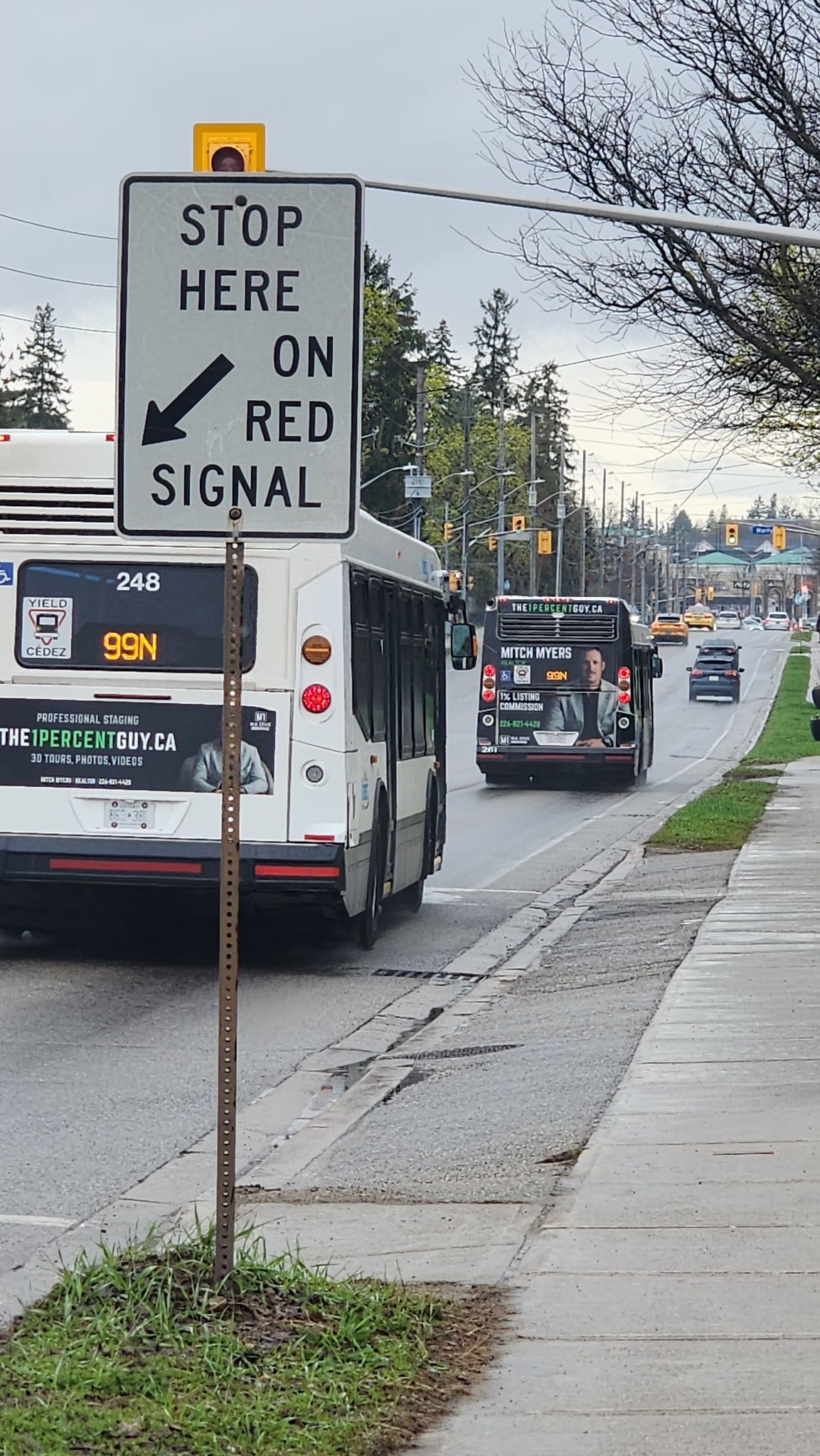
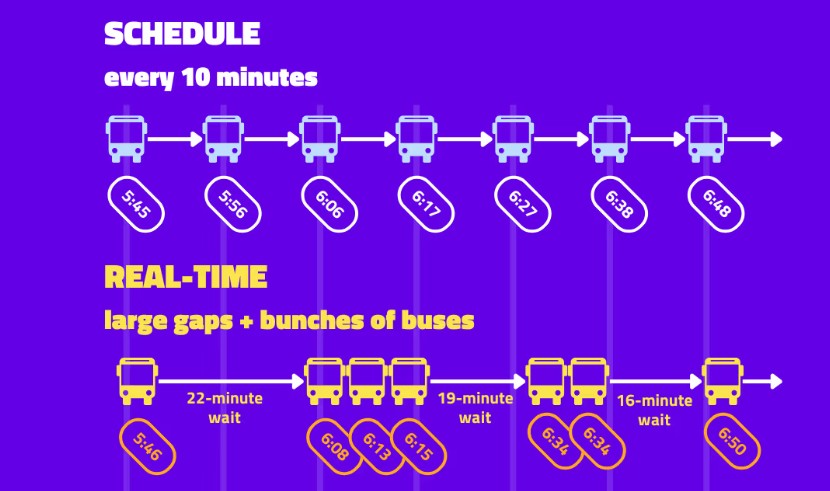
If you’ve stood at a stop on Gordon Street or Woolwich recently, you’ve likely seen the "99 Mainline Ghost": you wait 20 minutes for a bus that’s supposed to come every 10, only for two (or even three) to arrive back-to-back.
This is bus bunching, and it is the single greatest threat to transit reliability in Guelph. While the City’s Transportation Master Plan acknowledges these issues, the current timeline for major infrastructure improvements stretches toward 2029 and beyond.
At TAAG (Transit Action Alliance of Guelph), we believe the 99 Mainline needs a "Real Fix" today, not three years from now.
Understanding the Bunching Loop
Bus bunching isn't a result of "lazy drivers" or bad scheduling; it’s a mathematical inevitability in mixed traffic.
- The Trigger: A bus gets delayed by a red light or a large group boarding at the University Centre.
- The Accumulation: Because it’s late, more people are waiting at the next stop. This increases "dwell time" (the time spent with doors open).
- The Gap: As the first bus gets slower, the bus behind it gets faster because there are fewer people left to pick up.
- The Result: The buses "bunch" together, leaving a massive, frustrating gap in service behind them.
The Solutions: Beyond the Schedule
To fix the 99 Mainline, we need to move away from rigid schedule adherence and toward Headway Management. This means focusing on the gap between buses rather than the clock. However, operational software and "holding" buses at terminals can only do so much when the buses are stuck in a sea of private vehicles.
The Transit Priority Toolkit
While headway management is a vital operational tool, it must be supported by physical Transit Priority Measures (TPM) (PDF). These are the most effective ways to break the bunching cycle:
- Queue Jump Lanes: Short lanes at intersections that allow buses to bypass lines of cars and get to the front of the light.
- Transit Signal Priority (TSP): Technology that communicates with traffic lights to hold a green light longer or shorten a red light when a bus is approaching.
- Dedicated Bus Lanes: Giving the 99 its own space so that a collision at Gordon and Wellington doesn't paralyze the entire north-south spine of our city.
- Level Boarding and All-Door Loading: Reducing the time spent at stops by allowing riders to board quickly through any door.
Why 2029 is Too Late
The 99 Mainline is the backbone of Guelph. It connects our largest employment hubs, the University, and our downtown. Currently, the city plan suggests that significant transit priority infrastructure is tied to future road reconstructions and long-term capital budgets.
Guelph Transit riders are choosing to take the bus today. When the 99 bunches, students miss exams, workers lose wages, and the "choice rider" - the person who could drive but wants to take the bus - gives up and gets back in their car, adding to the very congestion that delayed the bus in the first place.
TAAG is calling for:
- Immediate TSP Implementation: Activate signal priority at key bottleneck intersections along the 99 route.
- Queue Jump Lanes: Use "quick-build" materials (paint and bollards) to create priority segments in high-congestion zones now, rather than waiting for full road reconstruction.
- Aggressive Headway Management: Empower Guelph Transit dispatchers with the tools to "hold" or "short-turn" vehicles to maintain even 10-minute spacing.
The Bottom Line
Headway management is the "Real Fix" for the internal operations of a transit agency, but Transit Priority is the armor that protects that service from the chaos of the street.
Guelph doesn't just need more buses; we need the buses we have to move efficiently. The 99 Mainline is ready for a move to the front of the line. Let’s not make the riders wait until 2029 to get there.
Join the Movement. Support TAAG in advocating for a faster, more reliable Guelph Transit. Together, we can end the bunching and keep Guelph moving.


